
Scientifically, What Makes Us Feel At Home?
Or the question that almost broke me.

Remember Millennial pink? This is her now. [Credits: Canva, Unsplash/Kier in Sight Archives] [See bottom for image description].
Dear readers,
Welcome to Burning Questions, the series where we attempt to find answers to little mysteries burning brightly inside your curious brains. Today, we are looking into Ani and Ben’s soul-searching wonderings:
Is there a scientific explanation for what makes us feel at home?
Buckle up, my untethered friends!
Readers. I have to be honest, this question feels like a subtweet (RIP). As someone who has lived in six countries and moved a ridiculous number of times, I genuinely do not know if I am the absolute most or the absolute least qualified person to write about this.
What is home? (baby don’t hurt me…)
I have certainly given this a lot of thought. Break out some tiny violins here, because sadly, I am not sure I have ever felt completely at home anywhere. No, not even where I grew up —maybe especially not in there. And right now, at a time of great turmoil in my personal life, this question feels more relevant than ever.
Turns out, Science is as confused as I am about what a home is, exactly. Is it a place (your town or neighborhood)? A physical space (your apartment)? A feeling (belonging)?
Is it a set of practices? Or maybe more of a state of being, one that could be described as “relaxed” or “at ease”? If so, is home no longer home when you are rage-Googling area rugs at 2 AM? What about when you’ve been binging The Pitt for 7 hours, and the walls start closing in, and your only shot at relaxation is actually going outside and touching grass?
Is the “feeling of home” completely socially constructed, or are there some universal biological markers connected to it? Well, at least we can all agree that ‘home’ entails some sort of walls, built on some sort of land… But if we did, would it mean nomadic people have never really felt at home?
Alright, alright. You get it. This question is not only burning, it’s also slippery. From neuroscience, to psychology to architecture, “home” is a deceptively simple idea that unravels into a whole tangle of multidisciplinary investigations.
Let’s start with the basics: For most of human history, people were born, lived, and died in the same place. You can still see it in our language: Many tongues, including my native Italian, don’t distinguish between “house” and “home.” Even English likely only split the two words in time: both trace back to the Germanic Heim, itself from the Indo-European kei, meaning “to lie down” and “something dear.” Home, in other words, is a beloved place where to rest your head.
So cute. So simple and romantic. If you are picturing a stone-wall cottage inhabited by farmers, or a picturesque castle home to a princess, think again. Pre-modern homes were noisy, stinky, and cramped with many generations (or even strangers who just ended up living with you, somehow).
Canadian American architect, Witold Rybczynski, explained this in his book Home: A Short History of an Idea. The ideals of comfort, privacy and domesticity of modern homes, he added, only emerged in the 17th century among the Dutch burgeoisie, reshaping both architecture and daily life. These ideas then spread across Europe with the Industrial Revolution and still underpin what we imagine a “home” should be today.
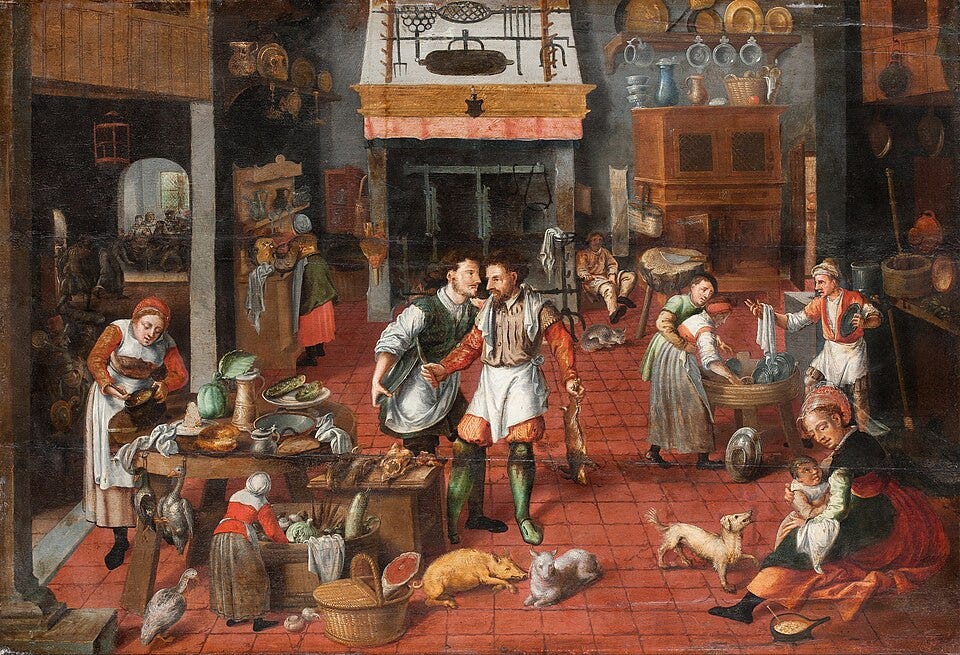
Charming. Castle Kitchen Interior, by Marten van Cleve. [Credits: Skokloster Castle, Public domain, via Wikimedia Commons] [See bottom for image description]
Since then, the meaning of home has grown into a constellation of personal, cultural, and scholarly interpretations. One of the most compelling perspectives I found comes from a 2025 paper which defines a house as a place that can meet basic physical needs (shelter, food, safety, and rest), and a home as a place that satisfies psychological ones: the need for autonomy over one’s choices; the need for connection with others; and the need for competence, the sense of being capable in life.
So the first answer to this question is that scientifically, we feel at home when our psychological needs are met, on top of our physical ones. The two are basically inseparable: Unmet physical needs erode psychological well-being, while psychological frustration just as easily disrupts sleep, eating, and our ability to feel safe.
Speaking of physical: Describing home as a feeling rather than a place isn’t just poetic – it’s grounded in what happens in our body.
Safety and belonging register in the body as much as in the mind. When you feel “at home,” the parasympathetic branch of your nervous system takes the wheel, slowing down your heart rate, deepening your breath, and turning energy toward rest, digestion, and repair. The vagus nerve, a kind of superhighway between brain and body, helps coordinate this shift, sending calming signals that ripple through everything, from your gut to your lungs.
Chemistry plays its part too. Often called the “bonding hormone” (although that’s a big simplification), oxytocin is released with wanted touch and plays a key role in establishing connections of trust and safety with people and places familiar to us, as well as getting us used to novel situations.
In familiar, socially secure environments, oxytocin can help suppress our stress response, in part by inhibiting cortisol, allowing the body to shift into a calm, regulated state. This biological pattern may be one reason why returning to known spaces — and known people — literally feels like a relief. So the second answer to the question is that scientifically, we feel at home when our body chills out in response to places, people or practices that feel familiar and safe.
Case closed, then. Or well… Is it? Forgive me if I am wrong here, but I spy I spy with my little eye a question behind a question: How do I find “home” if I don’t feel I have one right now?
Ah, yes, the dilemma that’s stumped me many a time. And I know many fellow migrants are on the same boat: Increased mobility, a fundamental characteristic of modern life, might have given us infinite opportunities to better our future, but has also scattered our attachments and fragmented our identities. Don’t I know it.
I found one more interesting piece of this puzzle in the utterly interesting but boringly named (sorry!), “Understanding home: a critical review of the literature”, by sociology professor Shelley Mallett, a summary of concepts from different academic fields. In it, she shares the perspective of phenomenologists like Sarah Ahmed and Craig M. Gurney, who understand “home” as a verb rather than a noun, something created by what you do in and with a place. That includes routines, lived experiences, as well as actions that have an impact on your community.
So here’s my conclusion, following that line of thought: If you want to feel at home, I think you just have to build it. You have to pick a plot of land — almost any plot will do, provided it can satisfy (today or tomorrow) your physical and emotional needs — and then just invest a bunch of time and energy into making it happen. The rest is truly, genuinely, just a matter of commitment, in my opinion. Of willingness to do what it takes to establish deep bonds that will make it hard to move again.
“People often ask me what is one thing I would recommend to restore relationship between land and people,” writes Potawatomi botanist and poet Robin Wall Kimmerer in her book Braiding Sweetgrass. “My answer is almost always, ‘Plant a garden.’ (…) A garden is a nursery for nurturing connection (…) And its power goes far beyond the garden gate”.
This book I recently read (and loved!) has given me more food for thought than most. “Maybe, the key to growing roots is to literally plant some,” I wrote on the margins.
Wherever home will be next for me, I think I might start from there.
References:
Breit, S., Kupferberg, A., Rogler, G., & Hasler, G. (2018). Vagus Nerve as Modulator of the Brain–Gut Axis in Psychiatric and Inflammatory Disorders. Frontiers in Psychiatry, 9(44). https://doi.org/10.3389/fpsyt.2018.00044
Critchley, Hugo D., & Harrison, Neil A. (2013). Visceral Influences on Brain and Behavior. Neuron, 77(4), 624–638. https://doi.org/10.1016/j.neuron.2013.02.008
Handlin, L., Novembre, G., Lindholm, H., Kämpe, R., Paul, E., & Morrison, I. (2023). Human endogenous oxytocin and its neural correlates show adaptive responses to social touch based on recent social context. ELife, 12. https://doi.org/10.7554/elife.81197
Heinrichs, M., Baumgartner, T., Kirschbaum, C., & Ehlert, U. (2003). Social support and oxytocin interact to suppress cortisol and subjective responses to psychosocial stress. Biological Psychiatry, 54(12), 1389–1398. https://doi.org/10.1016/s0006-3223(03)00465-7
Hill, V. (2022). Everything You’ve Heard About Oxytocin is Wrong. On Youtube.
"Home: A Short History of an Idea." eNotes Publishing, edited by eNotes Editorial, eNotes.com, Inc., 2 Sep. 2025 <https://www.enotes.com/topics/home-witold-rybczynski/in-depth#in-depth-home-1>
Howard, M. C. (2025). What is Home? Creating a Psychological-Based Framework of Home With Basic Psychological Needs Theory. Psychological Reports. https://doi.org/10.1177/00332941251329850
Jan Willem Duyvendak. (2011). The Politics of Home: Belonging and Nostalgia in Europe and the United States. Palgrave Macmillan.
Kimmerer, R. W. (2013). Braiding Sweetgrass. In Braiding Sweetgrass: Indigenous Wisdom, Scientific Knowledge and the Teachings of Plants (p. 134). Milkweed Editions.
Mallett, S. (2004). Understanding Home: A Critical Review of the Literature. The Sociological Review, 52(1), 62–89. https://doi.org/10.1111/j.1467-954X.2004.00442.x
Porges, S. W. (2007). The polyvagal perspective. Biological Psychology, 74(2), 116–143. https://doi.org/10.1016/j.biopsycho.2006.06.009
Thayer, J. F., & Lane, R. D. (2000). A model of neurovisceral integration in emotion regulation and dysregulation. Journal of Affective Disorders, 61(3), 201–216. https://doi.org/10.1016/s0165-0327(00)00338-4
Tops, M., Huffmeijer, R., Linting, M., Grewen, K. M., Light, K. C., Koole, S. L., Bakermans-Kranenburg, M. J., & van IJzendoorn, M. H. (2013). The role of oxytocin in familiarization-habituation responses to social novelty. Frontiers in Psychology, 4. https://doi.org/10.3389/fpsyg.2013.00761